
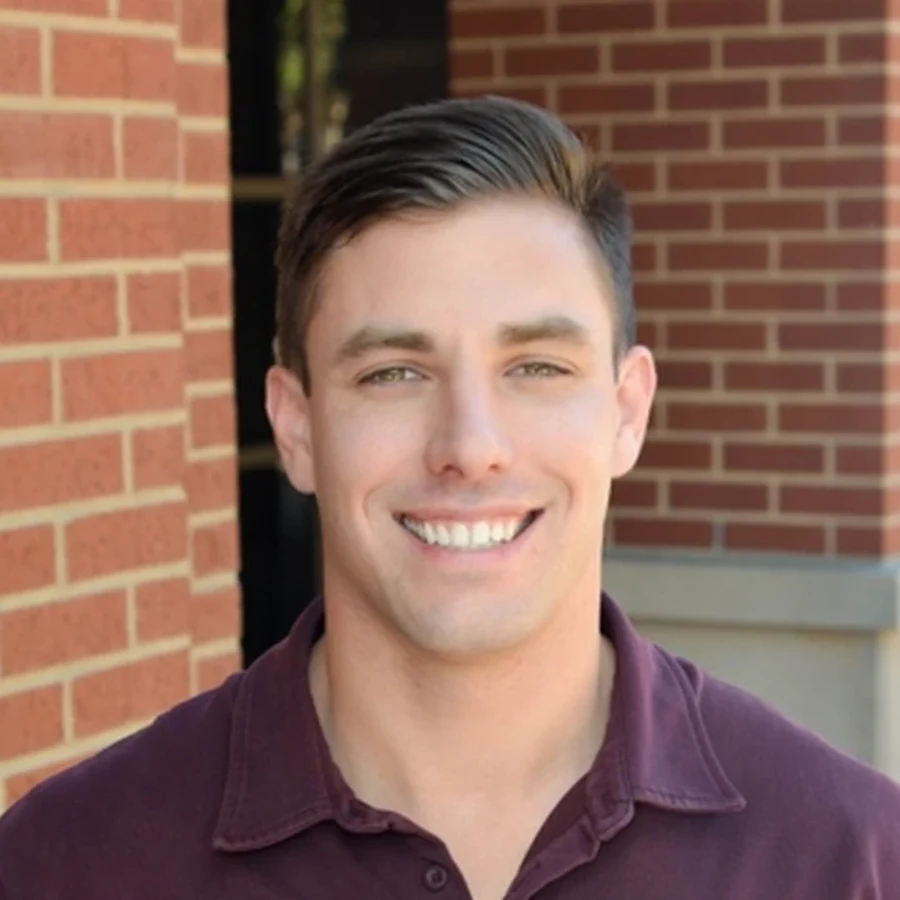
Employee spotlight
Ryan Grambow
Ryan Grambow is our Chief Growth Officer and the Director of our Enterprise practice. He joined CBC in 2026 after more than twelve years running large programs for Fortune 500 automotive manufacturers, airlines and aerospace primes, and scaling internal operations inside consulting firms. Before that he served as an infantry officer in the Marine Corps. He studied business management and data analytics at UT Dallas.
What brought you to CBC?
Honestly, it was the combination of scale and access. At a big firm you get to work on serious programs, but you're one person deep inside a machine and you rarely see how the real decisions get made. At a small firm you see everything, but sometimes there's no machine to see. CBC has enough reach to run serious work and is still small enough that I can pick up the phone and change something the same day. The other piece was the people. I met most of the team before I signed, and they were people I actually wanted to spend the day with. That's rarer than it should be.
What are you currently working on?
Two things, and they're pretty tied together. The first is our growth operations — how we bring work in, how we decide what to say yes to, how we staff it, and whether the systems behind all of that can keep up with the volume we're adding. The second is the enterprise practice itself. I decide what we offer, how we deliver it, and who delivers it. Most of my week is scoping conversations, time with the people on our programs, and calls that come down to one question: is this plan realistic. I keep growth and delivery on the same desk on purpose. The person making the promise should be the one finding the people to keep it.
What kind of work have you done?
I started as an infantry officer in the Marine Corps, and that's still the foundation for how I work. From there it was manufacturing and robotics, then technology, aerospace and defense, automotive and airlines. Mostly large programs — the kind with a lot of moving parts and a lot of people who each own one piece of it. I've also run operations inside companies instead of advising them, and I'd recommend that to anyone in this line of work. It changes how you write a recommendation when you're the one who has to live with it afterward.
What is a project you are proud of?
The Marine Corps gave me more than any job has, and I lean on it every day. But the work I'm proudest of is a facility expansion I planned and ran at the robotics manufacturer I was at. It was the first large-scale change I owned from the first conversation to the last one — the budget, the sequence, the trades, a production schedule we couldn't interrupt, and every person who had an opinion about any of it. Nobody was going to catch it if I got it wrong. Seeing it finished and running was the first time the work stopped feeling theoretical.
What do clients get from working with you?
A straight answer, every time. If the date isn't going to hold, I'll say so in the room — not in a status report a week later. Past that, I care about this work more than I probably should. Clients are people trying to accomplish something that matters to them and usually has their name on it, and helping them get there is the part of the job I like most. So I'm specific about sequence, about staffing, and about what has to be true for the plan to work. And I have opinions about who we put in front of you, which I don't hand off to anyone else.
How has your time here changed the way you approach your work?
I've gotten a lot better about developing myself. For most of my career I poured everything into building systems, building tools, and building the people around me, and I would've told you that was the right call. Then it caught up with me. You can only take a team as far as you've taken yourself, and I was running on skills I picked up years earlier and never went back to sharpen. Now I put my own development on the calendar like anything else I'm responsible for. Ironically, it's made me better at all the things I thought I was choosing instead.
What is it like to work at CBC?
Fast. We're growing quickly, and every day is a decision about how to grow without breaking anything. Saying yes to more work is easy. The hard part is making sure the systems, the tools and the operations behind it are keeping up — so clients get what we told them they'd get, and our people aren't the ones absorbing the difference. That balance is most of what I think about. What makes it a good place to be is that everyone here sees it the same way, and the firm is small enough that if something isn't working, you can say so and it actually changes.
What advice would you give to someone just starting out in their career?
Go fail at things. Take on work you're not quite ready for, as often as someone will let you, and be willing to be bad at it for a while. The one rule is you don't make the same mistake twice. Write down what went wrong, be honest with yourself about your part in it, and go again. Most people spend their early career trying not to get caught not knowing something, and they learn at a fraction of the rate they could. Do it the other way and in five years you'll look up and be surprised at what you can handle and what's open to you.
What do you do outside of work?
Faith, family and friends, in that order, and not by accident. My family is my whole world, and everything I do is for God and for them. Outside of that, I'm a Green Bay Packers fan — which means I spend every fall convinced this is the year, and every January getting my heart broken in the first round of the playoffs. I keep signing up for it anyway.
 Case study · Aerospace & Defense
Three-Year Go-to-Market Strategyfor Aerospace Technical Services
Built a three-year plan to grow anaerospace technical services line.
Read Article
Case study · Aerospace & Defense
Three-Year Go-to-Market Strategyfor Aerospace Technical Services
Built a three-year plan to grow anaerospace technical services line.
Read Article
 Perspective · Operations
Tools Do Not Change the Operation:Redesigning the WorkA tool inside an unchanged operationreports on the old problem, at speed.
Read Article
Perspective · Operations
Tools Do Not Change the Operation:Redesigning the WorkA tool inside an unchanged operationreports on the old problem, at speed.
Read Article
 Perspective · Implementations
The Project Starts at Cutover:Why Software Alone FailsGo-live is a milestone. Value depends onwhether people can run the new process.
Read Article
Perspective · Implementations
The Project Starts at Cutover:Why Software Alone FailsGo-live is a milestone. Value depends onwhether people can run the new process.
Read Article
Ready to tackle what’s next?
Let’s talk about what you are working on and how we would approach it.